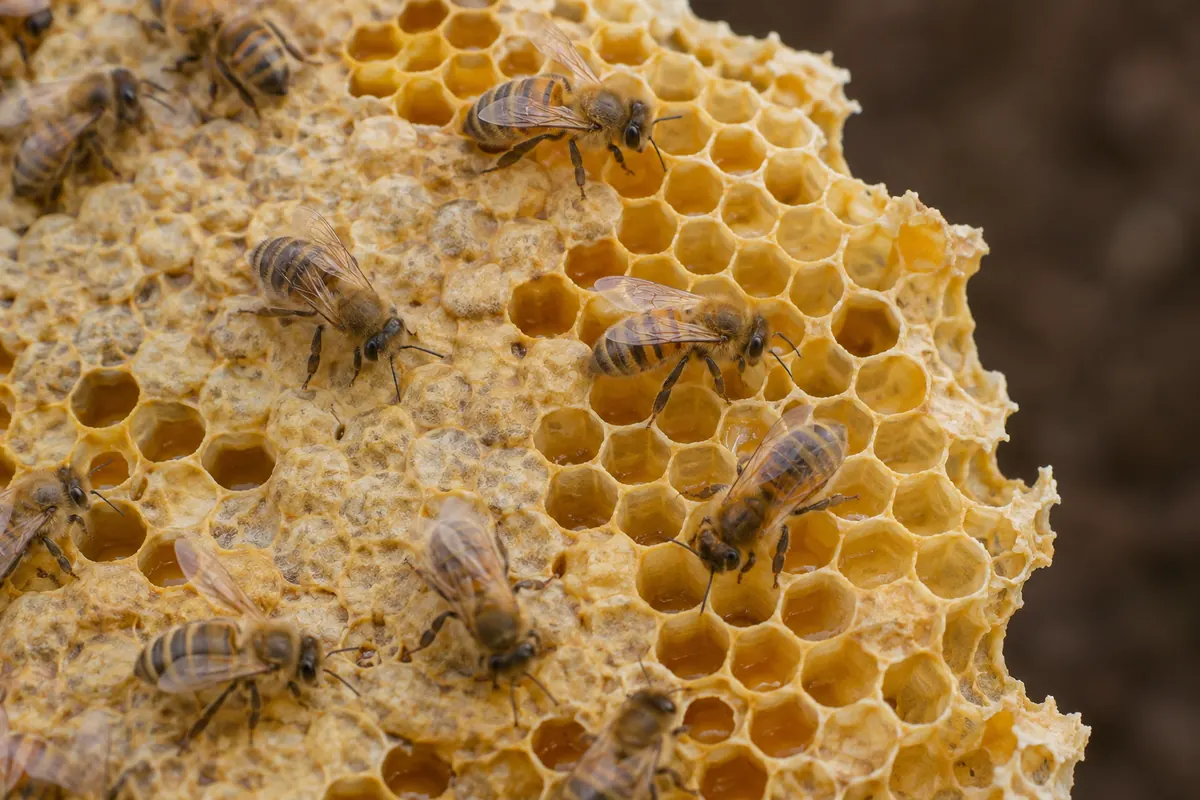
Bees: pollen collectors with varied nesting habits
Honeybees often appear fuzzy and brown-gold, while bumblebees are usually rounder and hairier. Carpenter bees can look similar to bumblebees but have a shinier abdomen. Appearance varies, and distant observations can be misleading.
Honeybees may form an exposed swarm cluster or establish wax comb in a cavity. Bumblebees and solitary bees have different nesting habits. Not every bee sighting requires removal, and not every colony can be relocated.
Wasps: a narrow waist and several nest types
Many familiar social wasps look smoother and more defined at the waist. Paper wasps often have long legs and open comb nests. Yellow jackets are more compact and may use ground cavities or concealed spaces.
Wasps can be beneficial predators, but a colony beside people’s regular routes can create a conflict. Nest location and activity matter when deciding whether an assessment is appropriate.
Hornets: part of the wasp family
Hornets are wasps, not a third unrelated category. European hornets are true hornets. Bald-faced hornets are commonly called hornets but are a type of aerial yellow jacket.
A large enclosed paper nest is a reason to keep your distance, not to approach for a precise species identification. The service enquiry can start with the shape, position and flight path you can safely see.
Compare the evidence, not just the colour
A cluster of insects on a branch, an open paper comb and repeated traffic into a hole can suggest very different situations. Yellow-and-black colouring alone is not enough to choose a treatment.
- Exposed cluster of bees: contact a beekeeper or bee specialist; we do not provide bee removal
- Open umbrella-like paper comb: may indicate paper wasps
- Enclosed grey paper envelope: may indicate an aerial social-wasp nest
- Small ground or wall entrance: identification and assessment still needed
Choose the next step
We do not offer bee removal or relocation. If you suspect honeybees, leave them undisturbed and contact a local beekeeper or bee specialist. For wasp, hornet or yellow jacket colonies, our service pages explain common nest situations.
Keep people and pets clear, leave the entrance open and call if the colony is affecting your property. “Not sure” is enough to begin the conversation.
General information helps you describe a problem; it does not replace an assessment of the actual insect and site.
Good to know.
01Do all bees have fuzzy bodies?
No single visible feature identifies every bee. Some look less hairy, and wasps can also have body hairs. Use several clues and seek help when identification is uncertain.
02Can I send a photo?
A safely taken photo may be useful when an appropriate sharing method is agreed. Photo upload is not enabled on this preview, and you should not move closer to get an image.