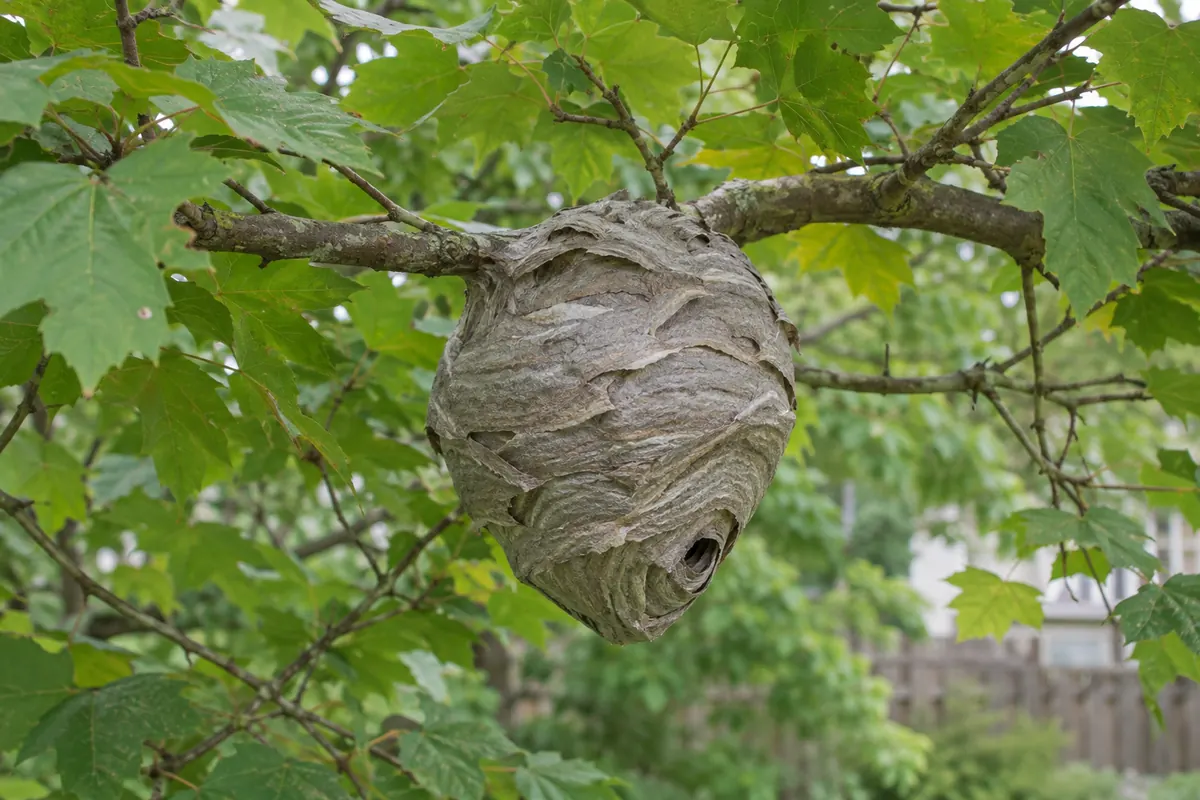
First, understand what is nesting there
“Hornet” is often used for several large social wasps. Bald-faced hornets are black and white and make enclosed paper nests; despite their common name, they are a type of aerial yellow jacket. European hornets are larger, with reddish-brown and yellow colouring, and may nest in sheltered cavities.
Colour alone does not confirm a species. Nest shape, entry points and activity are useful clues. You do not need to get closer or collect an insect before contacting us.
Where hornet activity becomes a concern
An enclosed nest hanging from a tree branch is easy to notice. Activity under an eave, in a dense shrub or entering a building opening can be less obvious. A flight path that crosses a door, walkway or play area deserves particular attention.
- Tree branches and shrubs close to walkways
- Roof edges, porch ceilings and exterior structures
- Sheds, sheltered voids and openings around buildings
- Repeated traffic to one spot even when no nest is visible
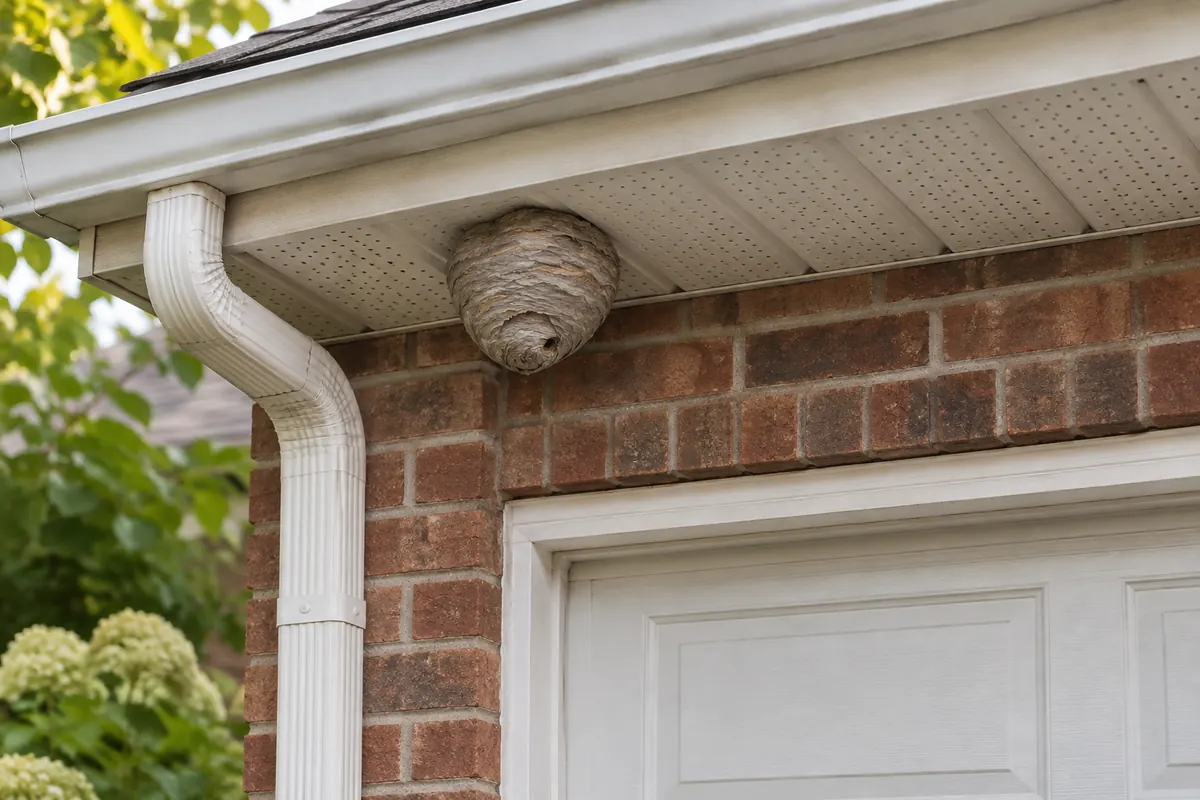
What a professional assessment considers
The starting point is the insect, the active entrance and the location of the colony. Height, ladder access, nearby people and whether the nest is exposed all affect the approach. A nest in a cavity can require a different plan from a hanging paper nest.
Treatment and physical nest removal are separate steps. Whether a nest can be removed, and when it can be approached, depends on the situation. Ask what the proposed work includes and whether any building access or repairs would be separate.
Before someone attends the property
Give the nest space and keep children and pets away from the flight path. Avoid pruning beside it, striking it or trying to wash it away. Do not seal an active entrance into a building before it has been assessed.
Describe the height from ground level, nearby doors or windows, and any access restrictions. A photo taken from an already safe position can help with identification, but getting a photograph is never worth approaching the colony.
Have a situation like this?
Request Your Free QuoteGood to know.
01Can you remove a high nest?
Height and safe access affect what work is feasible. Tell us which storey or structure is involved when you call. A visit and suitable access may be needed before the scope can be confirmed.
02Does an empty-looking nest still need attention?
A lack of visible activity during one observation does not establish that a nest is inactive. Avoid handling it until its status and the access risks have been assessed.
03Is hornet nest removal available outside Toronto?
Our current service areas are Toronto, Mississauga, Oakville, Scarborough, Etobicoke, North York, Markham, Richmond Hill and Vaughan. Call during 9:00 AM–5:00 PM daily to discuss your location and scheduling.
04What will the work cost?
Nest location, height, access and whether it is inside a structure affect the quote. We offer free quotes and explain the proposed scope before you decide.
Still have a question? Call to discuss your nest.
Call (647) 264-1706Daily, 9:00 AM–5:00 PMOr request a free quote