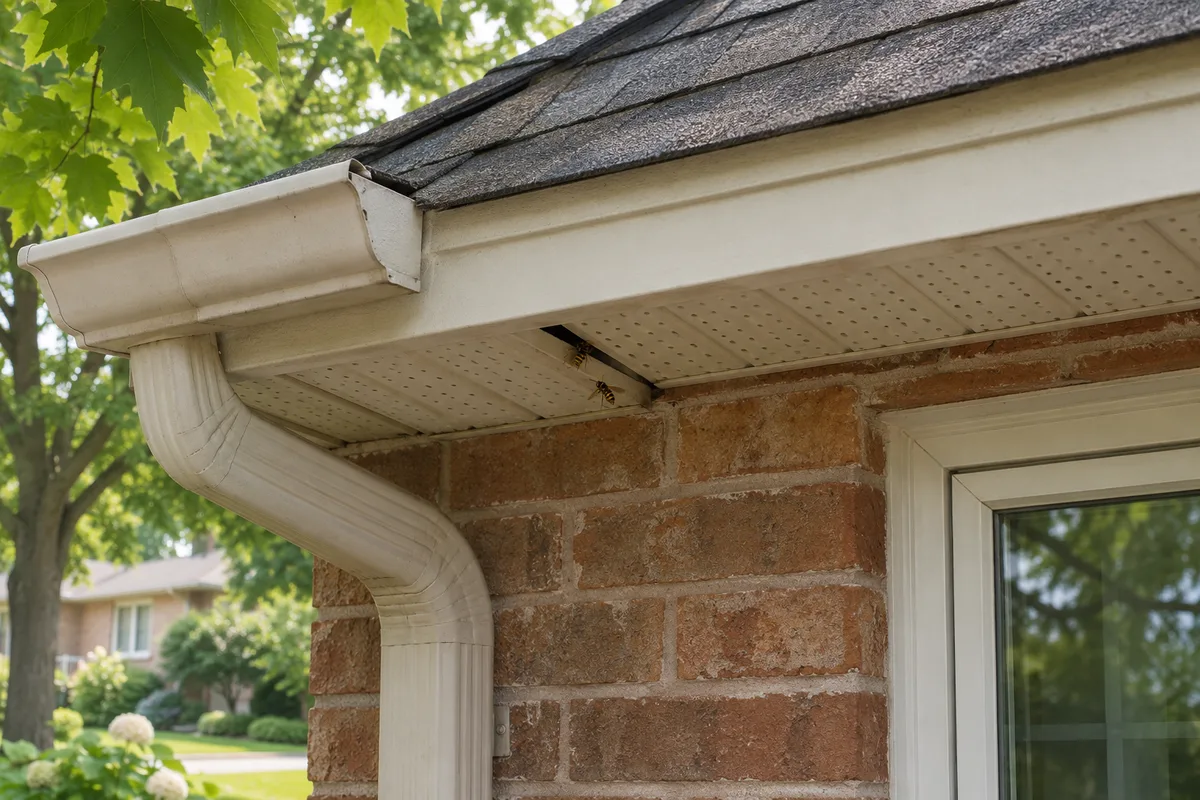
What to record before anyone enters the roof space
Note which roof edge or gap receives repeated traffic and the nearby window or corner that identifies it. Describe whether insects enter one point or several. A visible entrance does not establish the nest size, exact position or route through the roof space.
Report indoor sightings by room and location. Buzzing alone does not prove a wasp nest. You do not need to open an attic hatch, move insulation or approach electrical wiring to strengthen your description.
Avoid disturbing a concealed colony
Pause loft access, roof maintenance and insulation work close to the suspected location. Keep people and pets away from active indoor insects and avoid investigating above a ceiling. Tell a roofer or other contractor about the activity before their visit.
- Do not seal an active roof gap or vent
- Do not spray blindly into a roof space
- Do not remove ceiling panels to search for the nest
What an assessment and quote should address
Provide the building storey, roof access restrictions and any known hatch location. Do not enter an unfamiliar attic to measure it. Explain if the building is shared or rented so the appropriate property contact can authorize access.
Ask how the suspected nest will be located, whether treatment can use an existing opening and what follow-up is proposed. Nest removal, insulation work and repair of roof or ceiling material should be distinguished in the scope. Do not assume pest work includes restoring the roof envelope.
Repairs belong after activity is resolved
Use the provider’s instructions for follow-up and reopening the area. Report continued exterior traffic or new indoor sightings with their locations. A quiet period alone is not a reason to open a cavity or block its exit.
Once inactivity is confirmed, discuss damaged soffits, screening or roof details with a suitable contractor. Preserve designed ventilation and drainage. Keep the assessment details available so repair work addresses the actual access point rather than sealing unrelated openings.
Request help in Toronto and nearby service areas
Wasp Nest Removal accepts enquiries in Toronto, Mississauga, Oakville, Scarborough, Etobicoke, North York, Markham, Richmond Hill and Vaughan. Call (647) 264-1706 daily, 9:00 AM–5:00 PM Toronto time, or use the quote form.
Include your service area, the affected structure, approximate height and any access restrictions. Select “Not sure” if the insect is unclear. We offer free quotes; the proposed scope and scheduling depend on the actual situation.
Have a situation like this?
Request Your Free QuoteGeneral information helps you describe a problem; it does not replace an assessment of the actual insect and site.
Good to know.
01Should I open the attic hatch to check?
Do not enter or open a suspected active nesting area to investigate. Start with the exterior traffic pattern and describe any indoor sightings.
02Can you remove a nest without opening the ceiling?
That depends on location and access. Structural opening is not assumed; the assessment should clarify what is feasible and who would handle any repairs.
03Are a few wasps indoors proof of an attic colony?
No. Indoor insects can have different entry routes. Report the pattern so it can be assessed alongside the exterior activity.
Still have a question? Call to discuss your nest.
Call (647) 264-1706Daily, 9:00 AM–5:00 PMOr request a free quote